

After moving to a suburban area in the North of England I finally understood something that had long evaded me since a young age.
I had once learned that the united kingdom is the most obese country in Europe. This is still the case, but for the life of me I could never uncover why. From my position in London, the volume of obese individuals I would cross was truely always rather low. I could never contrive as to where all these fatties where, as the stated 30% obesity rate, I would only ever estimate a 5% or 7% obesity rate from within London.1
This is not said in favour of London, which is, like a lot of cities in the Kingdom, rapidly becoming a digital prison, but to question why it was such a distorted representation of the country of Great Britian. Living there all my life I would find it difficult to become obese even had I, for whatever reason, tried my hardest.
After leaving and staying in a suburban town near Liverpool recently I at last discovered the solution to the primordial mystery of where all tubbies of Britian habitate. My suburb is nearly identical to the once famous, now infamous, American suburban neighbourhood, complete with manicured gardens, lawns, Wide winding roads and superfluous SUVs. Where there are shops and local businesses, they are accessible nearly exclusively by Cars, buses run once every 40 minutes.
The only gym is also only practically accessible by car.
Therein inhabits the suburban Northerner, a lifeform as friendly as he is swollen.
While desiring deeply to escape the cavernous ungilating nest of London, Arriving here I could not help but be disappointed. Where I had hoped there would be a deep and sincere human community, There is a series of atomistic detached housing, Each with a brown picket fence, comedicly bulky subsidised EV SUVs and intrusive front-door surveillance and lighting, no doubt each owned by accomplished connoisseurs of the finest of the Menus of Dominoes and McDonalds.
Interestingly the institution of the suburban human was effectively criticised in the great cinematic excursis against contemporary modernity, Over The Hedge. After Rewatching the film a decade and a half after I watched the DVD so many times as a child I memorised the half the entire script by heart, it’s biting satire was so profound and masterful I have only been compelled to write this very commentary on this.
The film features a cast of animal characters, the first introduced is RJ the racoon and Vincent the Bear.
It is clear that RJ represents the atomistic urban wage-slave, the first shots of him tell us that he is surviving just below subsistence level, his money literally only barely able to afford him a single packet of crisps, with this he is clearly compelled by hunger and desire for security which it is obviously he does not have.
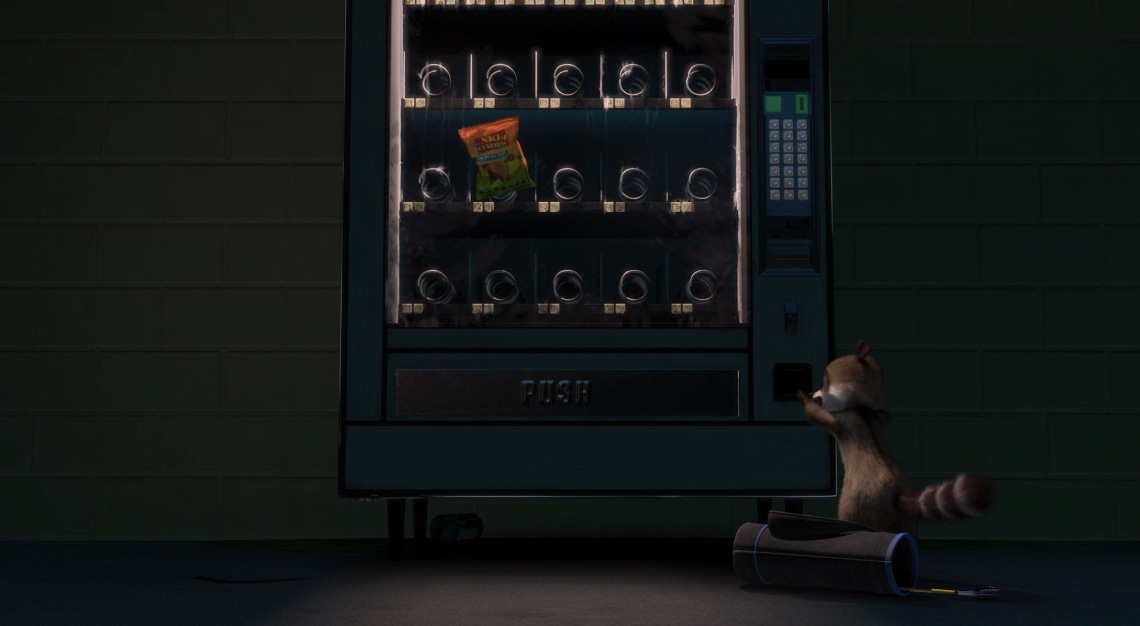
Despite this we learn that he is resourceful, and extremely cunning, no doubt a skill he has developed over his life only barely scraping by as opportunity jealously confers an absence of luck. He is compelled to seek out the food in a mountain far above his head where he knows is a stash graurded jealously by a sleeping hulking bear.
What happens is interesting, RJ successfully steals most of the stash but is compelled by his primary compulsion of greed to push his luck even further beyond nessesity. In doing this he is discovered by Vincent the Bear and captured.
This is where the film first begins to betray something beyond the simple intention to entertain children aged 6-12. To the audience’s surprise the bear begins to speak, and it is immediately implicitly obvious that the RJ the racoon and Vincent the Bear are in-fact transactional acquaintances in advance of the events of the film. Vincent expresses only moderate surprise that he his being robbed, appearing as though he has already put some thought into the possibillity that this could happen.
It is very evident that seniority indicates that RJ was probably compelled or coerced into the labour of collecting the food that constitutes’ some or most of Vincent’s stash of foodstuffs prior to the start of the movie. This explains why RJ knows about this stash of food, where it is and how to get to it immediately at the start of the movie.
This represents an extractive economic paradigm, indeed it foreshadows with great foresight for the creation of the film in 2006, the inevitable preponderance of contemporary Gig-Work, where RJ’s genuine and individual resourcefulness and cunning is used in irregular and inconsitent seasonal labour. It is clear that while RJ was working under coercion from Vincent leading up to winter, now that winter has arrived, and Vincent is comfortably hibernating, RJ is left without work or support and must now struggle to fend for himself after his irregular seasonal labour is extracted.
I find the heist symbolicly represents the attempt of a popular, populist or upstart revolutionary actor to overthrow a hegemonic liberal capital-based institution. RJ is hyper-competent, and extremely confident in performing this heist, but is brought down by his greed, liberal institutions know the inevitability and intrinsic nature of human greed and consequently inhabit it. RJ’s greed overextended his confidence into hubris, just as the embodiment of the visious atributes of liberal capital hegemony Vincent knew and expected it would, RJ completely defeated himself as most men do, with his own inability to control his own temptation. A carrot big enough becomes a stick in of itself.
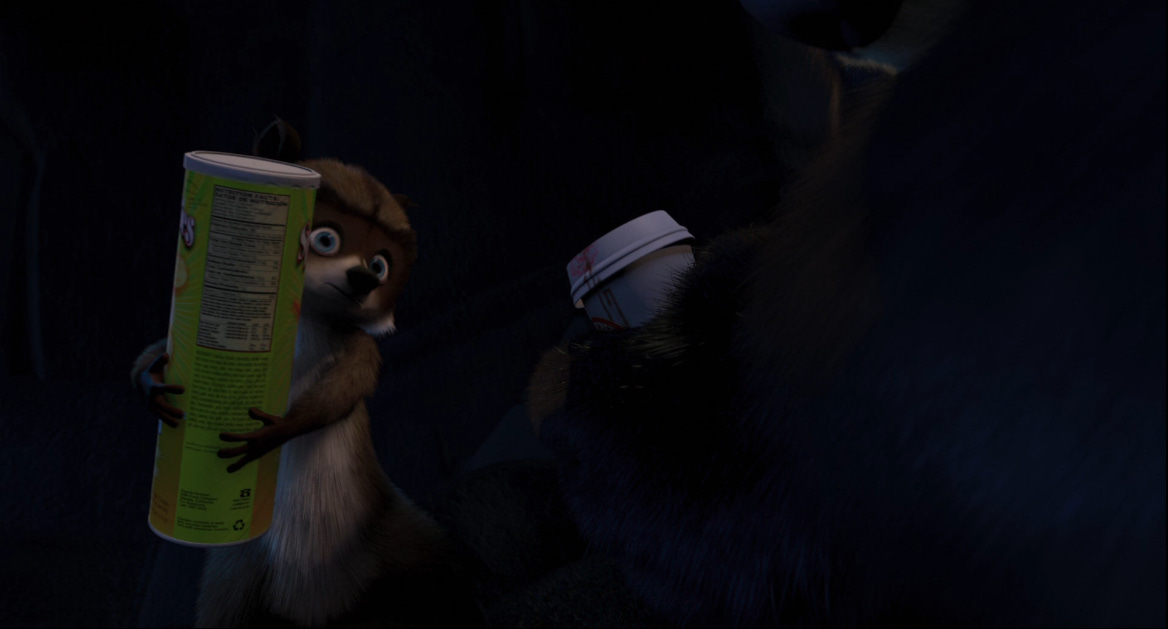
After the stash of food is destroyed by accident, Vincent the Bear threatens to kill RJ, until RJ pleads to recover the stash of food in it’s entirety. Vincent clearly knowing and expecting this bargaining cuts a deal stating that if he recovers all the food he has lost in 1 week marking the start of spring, he will not kill and eat RJ. Vincent states the motto and consolidating theme of the entire film “because enough is never enough” before the intro ends.
This starts the film, and the themes are already very rich. In particular the archetype of the Liberal Hegemon, covetously guarding his own wealth against younger and more capable and indeed more deserving opportunists. An archetype of the solitary individualist urbanite, a literal scavenger, searching for scraps amid the isolating wastes urbanised of civilisation.
The film proceeds in a manner where the complexity only expands. RJ the Racoon, the now desperate archetype of the individualistic roving scavenger must now contrive to some means to pay off his debt, a punishment inflicted on him for the unforgivable crime of his own ambition.
RJ is conflicted throughout the entire movie due to his own complete inability to separate his own Ambition from his Greed. It is his penultimate downfall and the primary conflict of the film.
From here on the we are introduced to a series of other excellently contrasting intellectual archetypes, who’s depth defy the confines of a family film. God only knows what Dreamworks Studios were cooking at the time of this film’s development.
---
After the Introduction passes the themes unwind.
We are introduced to the, the symbolic idealisation of the simple country folk of idyllic primordial rural civilisation, A Turtle called Verne leads this group with his cautious and superstitious instinct for danger. They exit hibernation and we learn that each member of the community represents a particular victim of contemporary modernity and it’s malignant inflicted harms.
Hammy is a squirel with Attention Deficit Hyperactivity Disorder. Stella is a skunk who struggles with her self-image, and is anxious about the internalised perceptions of those around her. Ozzie and Heather are representations of the modern architype of the weak patriarch and daugher ward who disrespects the practicality of his authority.
We learn than the primordial ruralists, due to the serene contentment of their circumstances, have collected only the precise amount required for survival while hibernating over the winter, Verne, the embodiment of primordial rural caution mentions that the community must collect more food to properly safeguard against starvation this coming winter.
This is interrupted by discovery of “The Hedge”. Much Ink has poured in the process of interpreting the depth and symbolic meaning of “The Hedge”, interpretations range from representing a loss of innocence, to the means to acquire genuine truth and gnostic knowledge, to a representation of the biblical story of genesis and the garden of eden. The movement from the biblical state of innosence toward the biblical state of knowledge.2 To me it represents the encroachment of Modernity into the once majestic and ancient serene rural landscape and way of life. It also represent the obfuscatory boundary between the parochial lifestyle including the culture of the rural being and the metropolitan cosmopolitan bustle of the Urban being. Those who live one way frequently and intutitively fail to understand or comprehend the manner in which the other lives and percives reality, hence the hedge obfuscating and separating one side from the other.
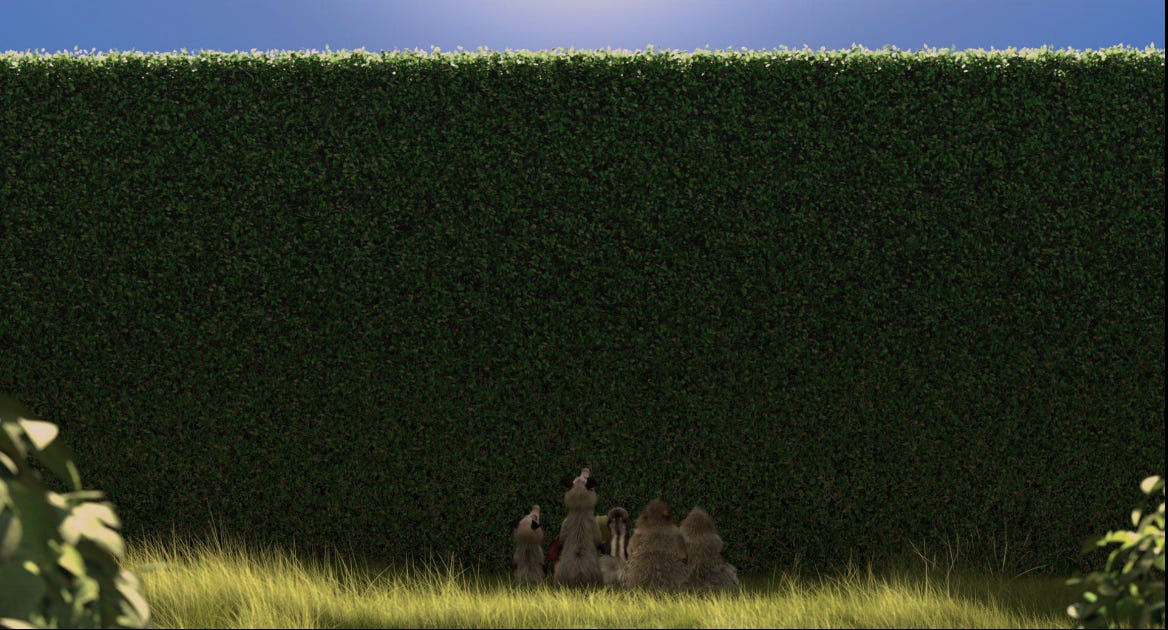
This is where RJ the racoon, the interlocutor of knowledge interacts for the first time with this biblically serene and innocent rural community. Here it is immediately obvious the contrast between the two lifestyles, This is represented by RJ the Racoon, Who is an ecological scavenger, while Verne, Hammy, Stella, the possums and Porcupines are a community of ecological Foragers. This conevys the systemic lifestyle difference between RJ as he introduces himself and the parochial and primeval ruralists to the temptations and excess of the Urban Landscape Through a packet of doritos, as an individual urban interloper his interest is obviously to extract the labour of this community to accumulate the food required to pay off his own looming debt to liberal modernity.
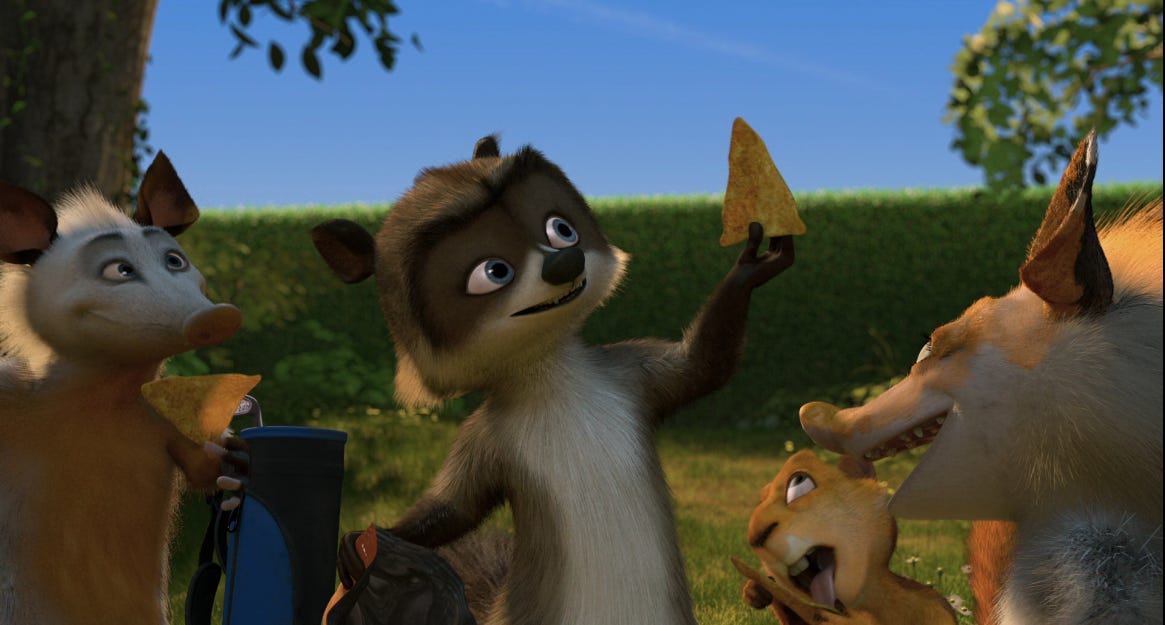
RJ, the experienced individualist interlocutor, offers to serve as a guide to the interwoven community of parochial foragers, enabling them to properly interface with this newly generated suburban superstructure. Immediately It becomes clear that the scrappy, pragmatic and entrepreneurial RJ is immediately conflicting with the cautious, responsible and superstitious representation creation of primeval rural life Verne.
The development of this relationship and dynamic over the course of the film is a major symbolic theme of modernist urban civilisation & historic pastoral rural relations which Dreamworks wishes to explore.
After an amount of pleading, the pastoral sage agrees at last to premiss an expedition into the morbid and turbulent perils of modernity, suburbia.
The satirical monologue from the roving vagabond RJ that follows is ingenious as it is insightful. His commentary and perspective on the entirety of suburban civilisation is that of an external naturalist, he sees the atomisation, excess and isolation of suburban civilisation as something that is as alien as existing as it is a rich opportunity for his benefit and extraction. In this way he embodies the mentality of the liberal/libertarian opportunist, he sees the near cattle-like arrangement of suburban humans as hunt to poach or harvest from, in this case for food.
As he explains the magnitude of excess within the suburban lifestyle it reminds one of how an entrepreneur would explain the market opportunity landscape for a business he wants to attract funding for. He describes his target market, their phycology and their market behaviour, he does this to betray the manner in which he plans to exploit it and it’s characteristics along with the help of his once idyllic company. In truth he his also exploiting them, To RJ this is the only practical manner in which he knows he can survive and even thrive in the (Sub)Urban jungle of modernity.
During this segment he provides pragmatic commentary on the observable paradigm of the suburban lifestyle. He states that human beings are slowly degrading their capacity to walk, and that each SUV only has room to carry one person at a time. We learn that the woman in the house RJ is using for his demonstration is the head of the local homeowners association and is scolding another homeowner for failing to maintain her lawn to excessively meticulous standards.
Nonetheless, eventually RJ’s opportunistic urban hubris causes him to obfuscate the real and probable risks of Urban Civilisation. Once they eventually become apparent the Pastoral Sage, Verne the turtle is outraged and infuriated. He decides to retreat with his community away from encroaching suburbia, attempting to return to the prior practices of life. The issue here is that modernity has destroyed most of the Forrest and the idyillic pastoral way of living has been eliminated with it, The consequent serene bounty and lifestyle has been paved over and destroyed, It is only through the extraction and plunder of this modernity as RJ insists is required can they now aspire to survive.
It also represents the allegorical fall of man, (But with animals). It is clear that after tasting the forbidden doritos for the racoon of knowledge, most in the community of animals would not want to go back even had they the oppertuinty. Possibly they now for the first time they are naked, the nuts and berries borne through their labour do not compare the the overfollowing excess that they know is now out there.
This also represents the malignant and expansive effects of modernity, in virulently expansive manners and capacities, as well as it’s wanton and uncaring destruction of historic and archaic culture, civilisation and organisation. It works in a manner which is multifaceded and complex. The use of temptation is so effective, that most people do not reconginse that the tradional and no doubt healthier culture and way of life is gone only after it is too late.
Nonetheless, once truth finally becomes apparent, Verne permits RJ to return to the community as a guide and lead them to survival among the suburban jungle.
What follows is RJ’s first attempt at the extraction of the bounteous booty of contemporary civilisation. He attempts this with Hammy a squirrel, a member of the pastoral community. I personally believe each member of Verne’s rural community represents an example of the delirious effects of modernity on the human (perhaps in this case animal) condition. It is very clear that Hammy represents the archetype of the young teenager with what appears to have what contemporary civilisation would refer to as “Attention Deficit Hyperactivity Disorder”, an example of a person who’s energy and vitality would be destroyed, inebriated or otherwise used extractively against him by the forces of contemporary life.
With RJ, however he is an excited plunderer of Americn Girl Scouts Cookies, the retrieval of which is highly successful, while featuring the intervention of the Verne the pastoral sage. During this sequence the head of the (human) Homeowners association in this suburban development is present and obviously completely outraged. The film permits us to hear here conversation, wherein she betrays her largest concern with the presence of these wildlife creatures. She states plainly that if word gets out regarding the presence of these free-roaming scavengers it will suppress the property values of the local area, including hers.
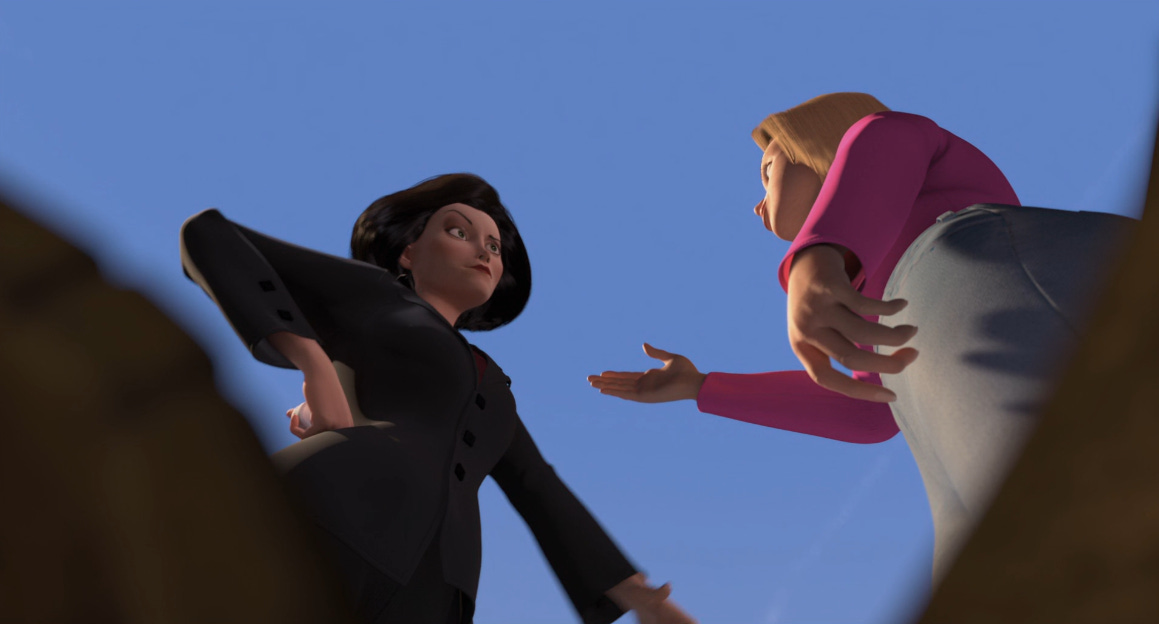
This is an interesting commentary of the finance and economics of suburban properties and developments, In the UK The Town and Country Planning Act operates as a mechanism for members of a suburban community to repress and control the development of new housing, developments and properties in local areas, the effectiveness of this system in the country is so well known it has acquired a name, we know it as NIMBYism (Not-In-My-Back-Yard(ism)). The Town and County Planning Act permits residents to enforce conformity and what I call Asset-ism, the quality of making an item or property most like a tradable financial asset, to every property in a community.
With it new developments, businesses and activities are suppressed or controlled so as to ensure that they do not disrupt the increase of property value.
The stated reasons for this behaviour usually vary from conservation, safety, suppressing loitering, environmentalism and more. In most cases however the truth is that the largest factor in the suppression of new developments or planning permission derive from a desire to ensure the assetification of a collection of properties. To most people a house is the most expensive asset they will every own, and due to the preponderance of the mortgage, any amount the property appreciates in value over inflation is total profit which they will later acquire once the mortgage is repaid and the property eventually sold. Ultimately the biblical sin of Usury compels people to greed and extraction, and explains the uniformity and sterility of many forms suburban and indeed urban landscapes.
This expansive dominance and NIMBY control of a country’s entire public planning system does not exist in the US however as it does in the UK, Consequently the American “Homeowners Association” fulfils this equivalent purpose. A homeowner’s association’s purpose is to ensure the property value of a community of homes continues to increase through time, sometimes issuing fines for non-compliance.
Ultimately, at no point here or at any point during the film is there any indication of a shared culture, community or communal organisation within this sterile and completely uniform collection of houses. Obviously a “community” of any kind is not the point of a suburb, such a thing is optional. If a suburban inhabitant so desired he could live completely and comprehensively isolated and entirely unassociated to those around him. “Community” and it’s authority, in so far as it exists, is impersonal, cowardly and coercive, working only through these bureaucratic planning authorities or angry beuracrats.
Ultimately Over The Hedge effectively represents the phenomena of a suburb being a collection of intersecting financial asset portfolios designed for wealth accumulation and it’s consequent effect on the lived environment, not only in the film, but naturally across the world.
---
From this point onwards the film conveys how RJ has organised and coordinated the community into a well oiled organisation for plundering the bounteous bosom of modernity. A sequence emerges as the entire community heaps the food required for RJ to pay off his looming debt. As this happens Verne, the pastoral sage, is growing increasing concerned.
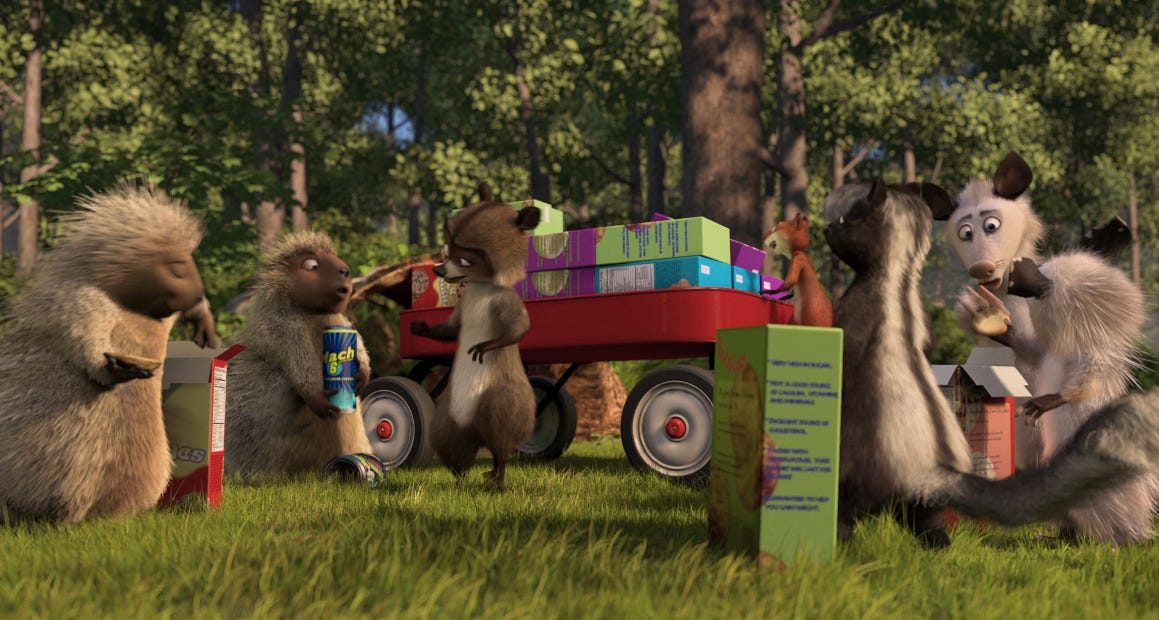
Verne is cautious and more than anything is intimidated by the awe-induing excess and power of modern urbanised civilisation. Like many rural folk, the metropolis is something who’s magnetism and power induces respect, like it carefully guards more fearsome dominance than it at any one moment betrays.
Unlike RJ, a lifelong subsistence scavenger who has inhabited the confines of modernity likely since his birth, and consequently neither fears nor seemingly respects it very much, Verne projects an ominous power onto this known urbanised universe and fears upsetting it.
Despite this it is clear that the entire community is extracting great value and intense meaning from these excursions to acquire food.
Eventually this comes to a head with the emergence of this ominous power Verne had been fearing. Urbanised modernity was not going to sit idle as it’s riches were viciously and opportunisticly plundered, this agent of retribution emerges at last as the “Verminator”. An Animal exterminator.
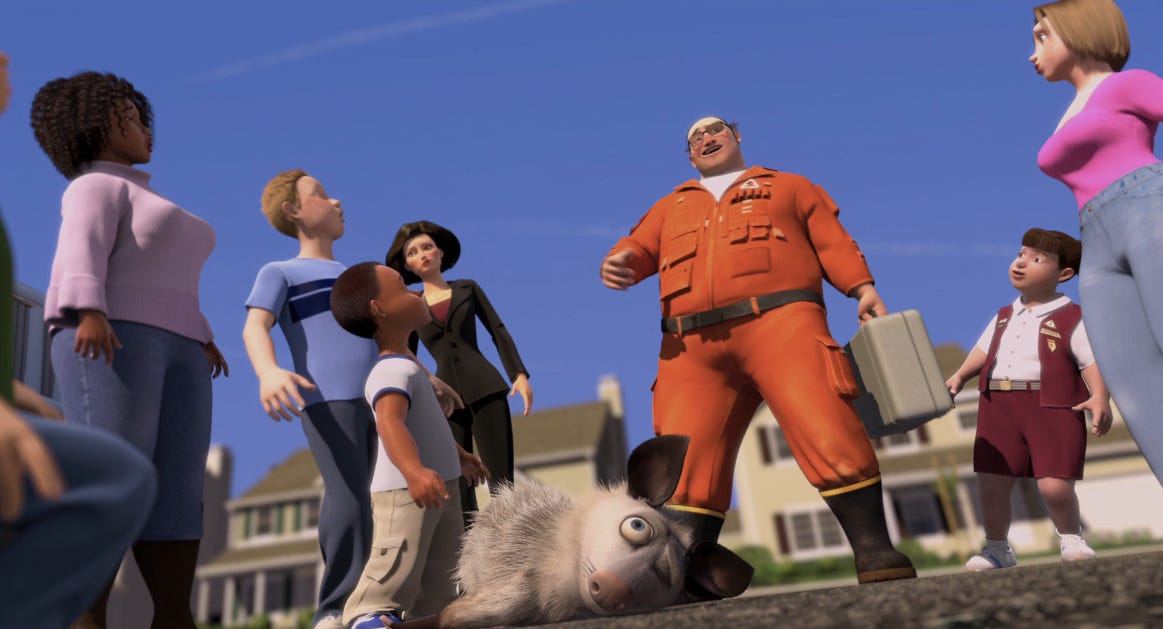
There are a few interpretations of who the Exterminator would represent, he could be a law enforcement agent, he could also be a federal operative, regardless he his a secondary custodian and representative of the monopoly of violence innate to all modern states. A mandatory attribute of all contemporary liberal and indeed illiberal states is the precondition of the monopoly of force or the monopoly of violence, this is represented to most as the police, but includes all other forms of state force, for instance the secret services or the army.
The theory of political philosophy regarding this concept seeks to explain the authority and legitimacy of centralised states. It is theorised that the state must be empowered, and conversely the citizens of that state disempowered, in order to confer authority required to run a functioning centralised government. International liberal NGOs continue to enforce this Idea as a natural precondition to statehood, the fundamental natural consequence of this political governance however is the depersonalisation of the governing structures of power.
States that can consolidate the power required to enforce their governance require a near total monopoly on the use of violence. This is something that initially sounds partially illiberal, It did so much so that the writers of the US constitution actively sought to inhibit it in advance with the very invention of the second amendment. A possible contributing factor to the US’s Military dominance may well be this, as the government is forced to accumulate greater reasorces and state violence capacity in order to enforce a comparative monopoly on violence over the general population which has itself a privileged capacity for violence, and secure the authority of the government.
Nonetheless, where the state accumulates legitimate force, functions and services away from the public, the inevitable and nessesery consequence is that community, and the communal applications of force, functions and services are destroyed or eroded. By their fundamental nature, the conceptual ideal of the modern liberal state requires the intentional destruction of any pre-existing communities, tribes or communal organisations which contravene the indended atomistic organisation. This is because such organisations weaken the comparative dominance of the liberal state or it’s standardised extractive financial interests.
The Exterminator represents the delayed but inevitable responciveness oof the monopoly of violence retained by the contemporary centralised modern state.
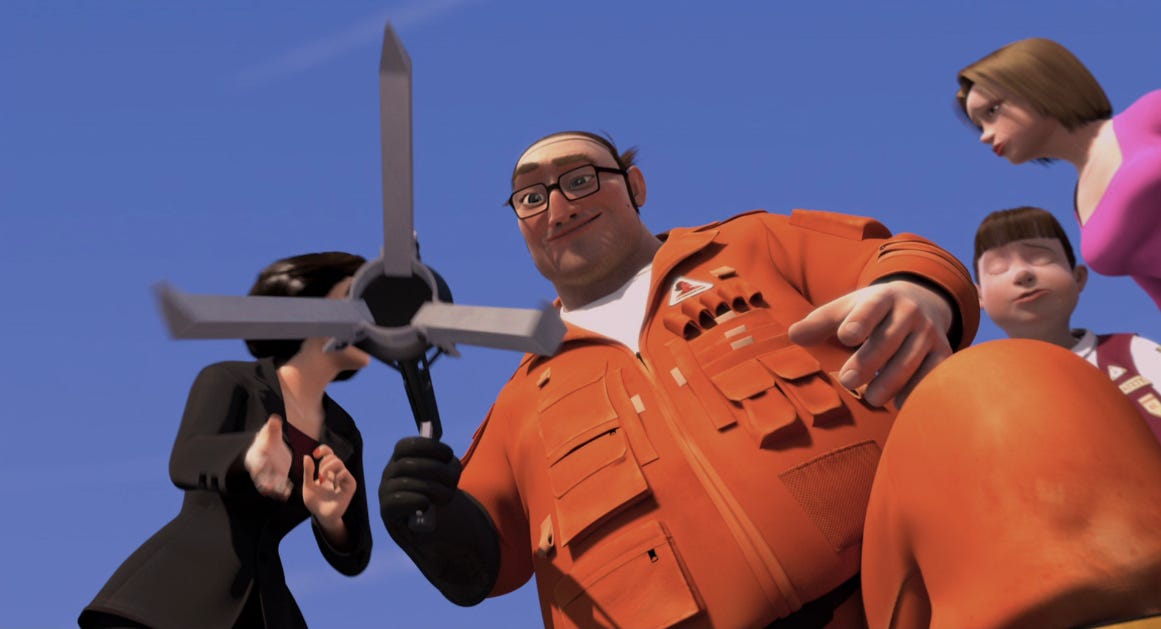
Nonetheless, we only have a glimpse of this Exterminator, What follows is a scene which begins to induce development of the character of RJ. After returning from this final excursion required to pay off his debt, he is greeted by the kindness and generosity of his tribal and primordial rural community, as a surprise for him they’ve cordoned off a section of the woods in order to provide him his own personal recreational environment.
Here he has a TV, Universal Remote, Red bulls, popcorn and sofa for his and his community’s enjoyment. They have unconditionally provided and upholstered for him everything he might ever want from the land of excess and modernity in a microcosm just for him.
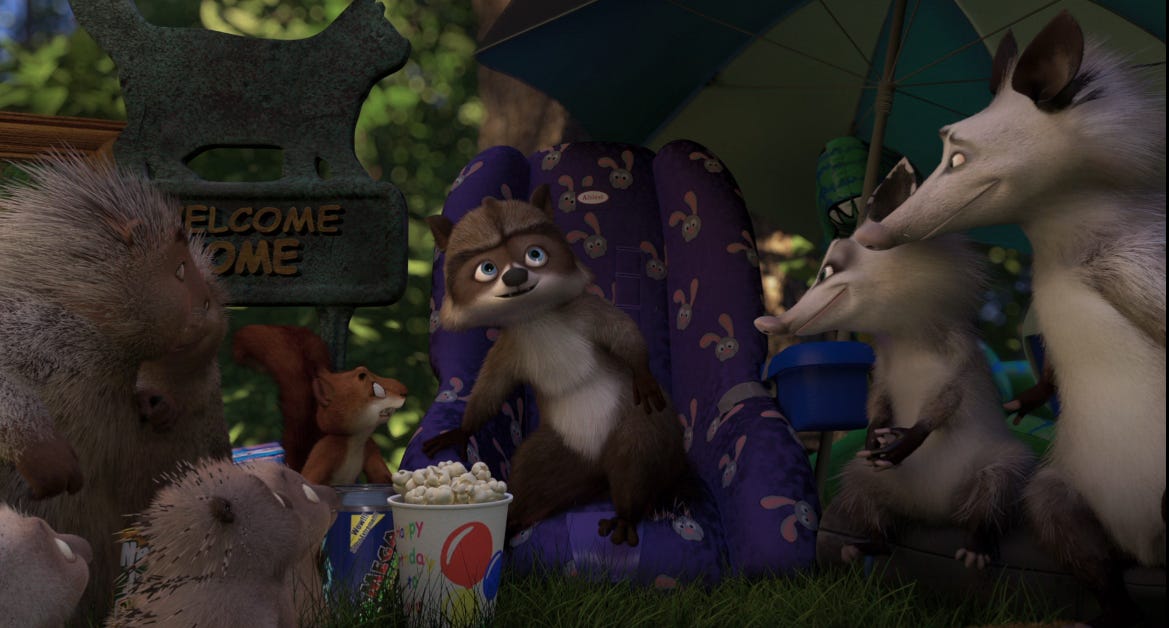
It is here that you we begin to see the opportunistic scavenger archetype of RJ first intially begin to break down. It is clear his guilt for manipulating this community who now only sees him with immense gratitude and a collective desire to accept him as family, permeate his personal condition. His initial intention, to deceive and extract the labour of this community to serve himself is beginning cause him to have doubts about his methods. The pull of this primaeval rural community is slowly imploding his individualist libertarian sprit such that he is shown suffering from a panic attack.
The next sequence show’s RJ’s anxieties converting into a panic as he rapidly discovers that Verne has decided and is the process of returning the entirety of the food they have each collected to the same suburban community it was pillaged from.
The internal philosophy behind this behaviour in Verne’s decision making is coherent and well foreshadowed, To Verne the magnitude of the Urbanised world is mysterious and ominous, he is fearful of the ease in which the excess they have accumulated has deviated from the natural course of life and will attract some form of delayed imminent retribution. Like all urban rural pastoral individuals his respect for the awesome magnitude of urbanised civilisation, induces a fear of taking advantage or to antagonising it. He is correct in recognising that attempts at retribution are imminent, yet RJ is comprehensively outraged and entirely manic as he discovers that the only way to pay off his debt and survive following the end of the week is being wheeled away in-front of him.
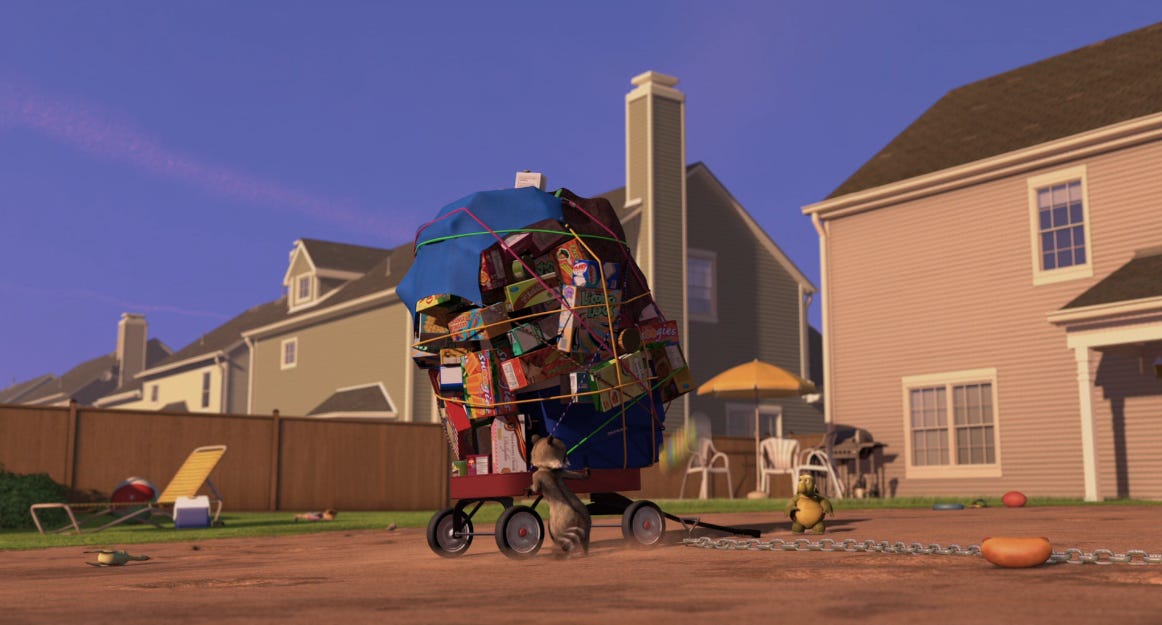
Clashing interpretations and philosophies around contemporary civilisation ram into each other, RJ, being a creature of modernity is systemicly desperate to escape the paradigm of usury modernity has inflicted upon to him as a vagabond. to him urban modernity is a system to inhabit, utilise and thrive within, not a force in and of it-self. He recognises distinctions, forces and organisations within urbanised modern civilisation and seeks only to exploit and utilise them. Verne has no motivations or intention in coming to diffenciate urbanised civilisation. To him “it” can be coalesced into almost a single ungliating force than can be antagonised and consequently must be respected as a comprehensive wholistic approximation of an “entity”. A form of mystical, or perhaps even hyper-systemic thinking that RJ does practically not comprehend.
The conflict and competition of ideologies is ultimately so destructive that it results in an action sequence whereby the entire completed stash of food is destroyed.
The resultant effects of this is catastrophic to all parties involved, especially both Verne and RJ. Once the entire community discovers that the fruits of their labour and cunning have been destroyed a fracture forms for the first time, isolating the Primordial Verne from the very community he himself lead. RJ is miserable and undergoing a profound state of loss at the security of his live as the community rallies to his care.
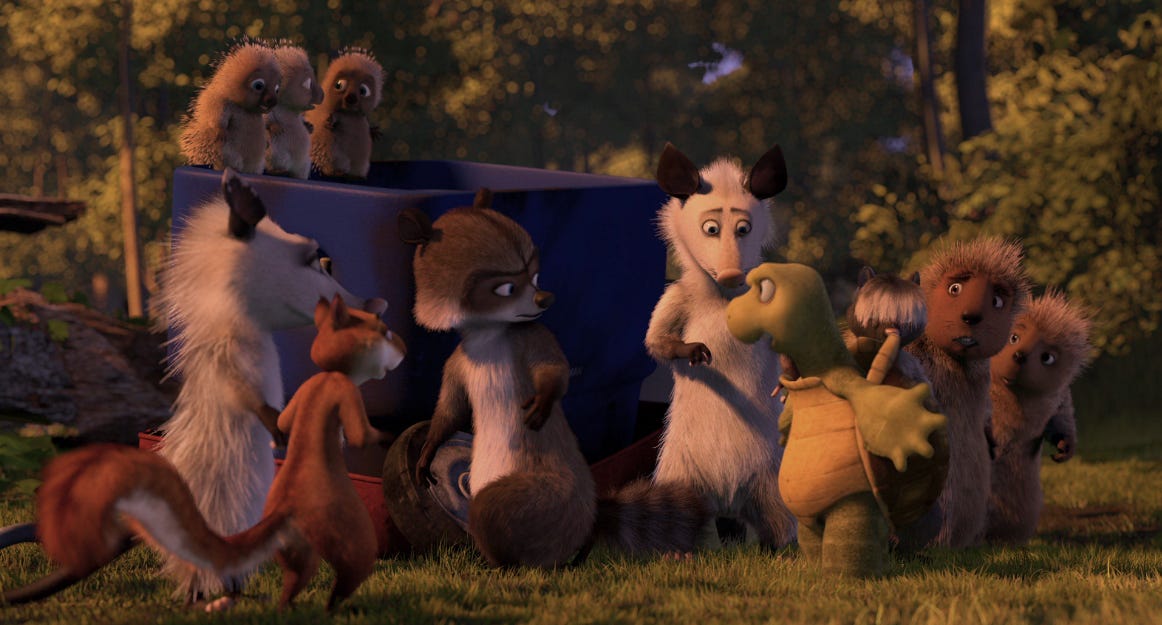
RJ seems to have a right to this indignant, during the course of the action sequence it was Verne’s intransigence which resulted in this outcome, against RJ’s recognition and warnings of the danger.
Ultimately after a night passes the pastoral Verne a period of introspection returns to RJ to open up honestly about his guilt and contrition at his act of destruction. RJ is clearly at this moment about to break down and the sly self-confidence to reveal the reality of his situation and consequent deceit he has inflicted when he discovers that the head of the home-owner association is hosting a party, and he contrives of an idea to save his life.
It is here that the film approaches it’s best portions.
The heist section of the film introduces us to the hare-brained scheme which involves seizing all of the food required to pay back Vincent in a single night. It is here that the stakes and actions ratchet exponentially. The film describes how Stella, will seduce the Persian Cat guarding the food to enable the heist. Clearly Stella represents the modern woman, who’s self-confidence attached to notions of her beauty, is second guessed by the infrastructure of capital based insecurity designed my modernity to subjugate and extract her identiy.
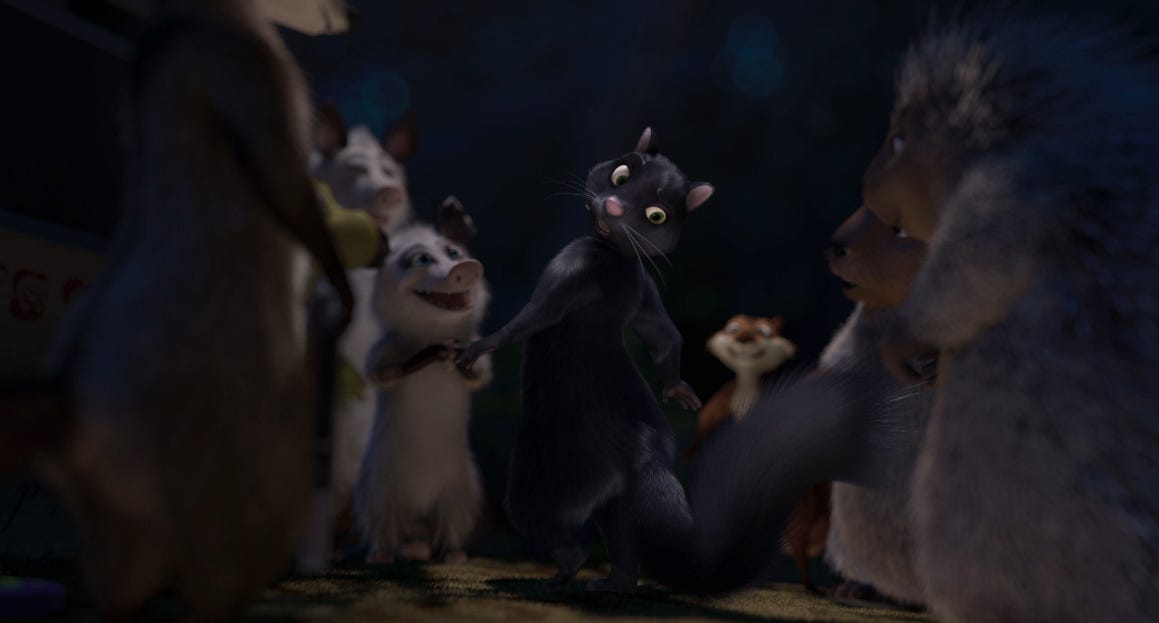
Through the process of the Heist, she actualises into achieving self-confidence. So too does Ozzie and Heather, the representation common in modernity of the weak male patriarch and his disinterested teenage daughter. Their who’s mutual actions bring them to transcend the modernist paradigm, producing a line of trust between the father and daughter that is natural but was once absent.
Ultimately at the last minute before leaving, RJ notices the Pringles and demands to stay back to acquire them even as the head of the home-owners association wakes up and is moving within the house. Throughout the entire film Pringles represent the concept of temptation, the slightest bit of excess, of greed, which will cause catastrophe, the Pringles are what has put RJ in this position under bond for his life in the first-place, and they are what cause the downfall of the entire operation now.
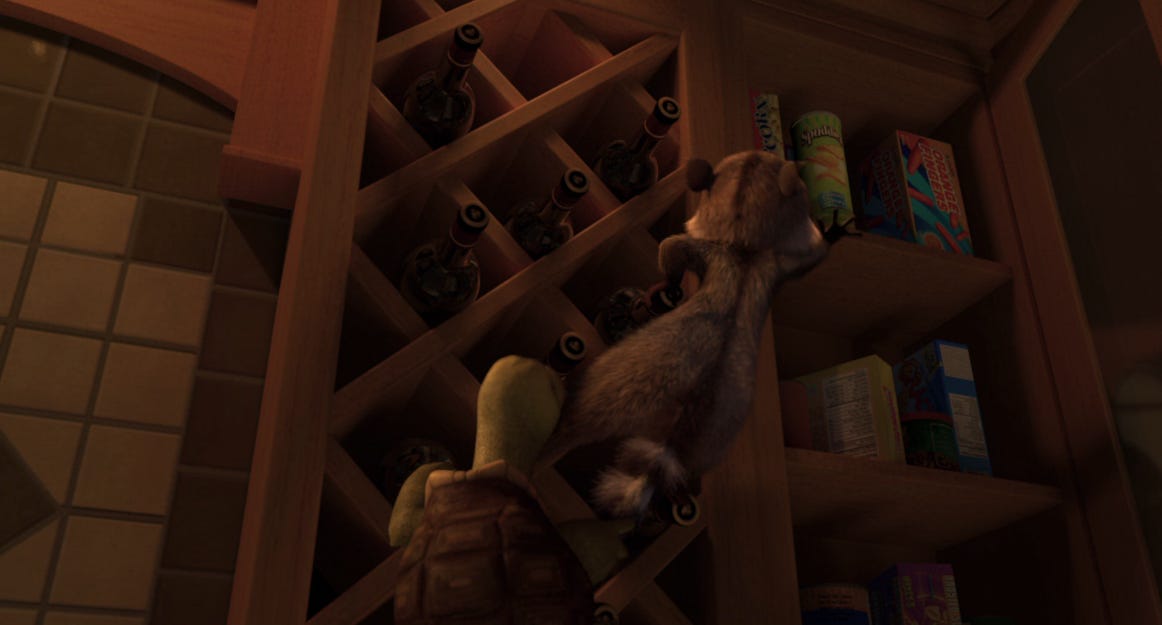
In desperation RJ reveals his betrayal, that the food collected was not for the community, but for Vincent, the black Bear. After this the whole house descends into chaos, ending with the Exterminator, the symbol of government force, detaining and capture every animal besides RJ himself, who must now return the stash of food back to Vincent before it is too late.
Before this moment however the Heist was seamless and pristine, The entire community operated to fill every role perfectly and would have gotten away with their crime unharmed. Like organised crime, It was the individual ego and temptation only, that could be relied to collapse the group, if the group had each-other’s back and kept their greed and opportunism under control, the systems of modernity seemingly could not have stopped them before it was too late. Greed always will have you defeat yourself, and divide and conquer always sucseeds.
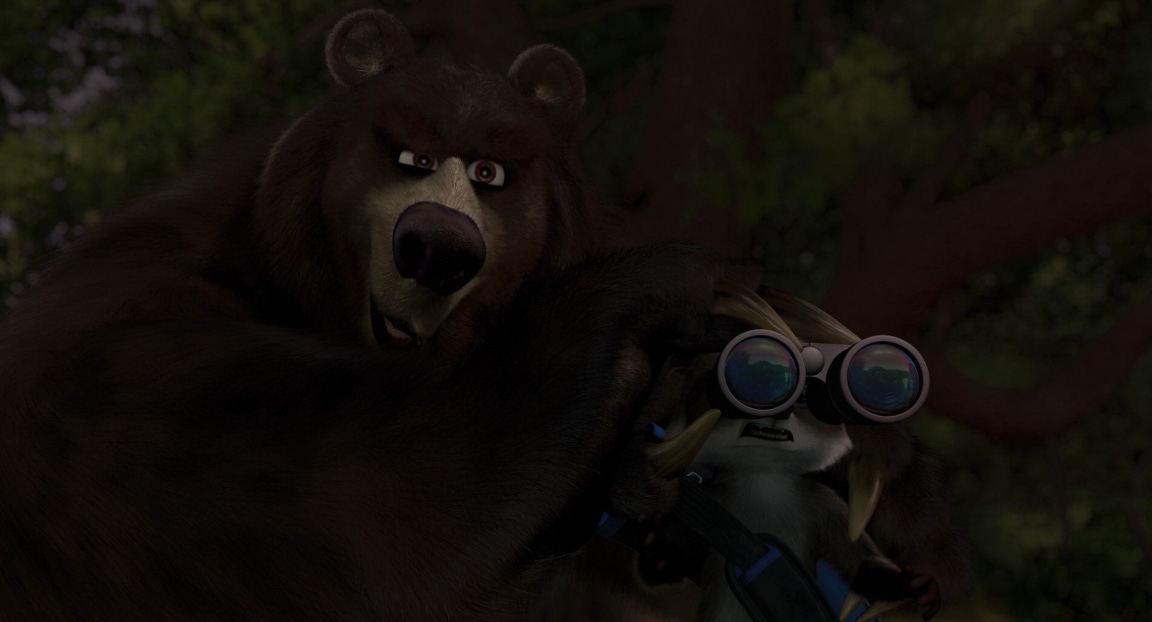
Either way, the individualist “rat” or informant, who saved his skin at the expense of his community is the modern world’s greatest asset for it’s defence, at this moment this is RJ. He has abandoned the only community we can so far see that he has ever had and after retuning the food to Vincent is told he has achieved greatness. “Soon you will be just like me.” Vincent states as he is impressed by RJ’s ruthless betrayal of his closest and dearest friends, all in exchange for material extraction.
In the modern world, notions of morality are universal, expanding beyond one’s closest community to encapsulate the entire world or more. This conflicts with the traditional tribal or even Confucian perspective that the morals and interests of larger society or government may be contravened to preserve the interests of those closest to you. Protecting the interests of your closest freinds, family and commuity superseeds the law. This is in contrast to the Platonic society of the Republic where all people apply the law and bounties of civilisation equally under a nation irrespective of their personal relations.
At this moment, however RJ is struck by heavenly inspiration from the jade court to imbibe the teachings of Imperial China and, realising his betrayal of his community is in contradiction to the Confucian moral code of confraternity, realises he must act urgently if he is to restore balance to the Dao.
RJ decides cinematicly at this moment to betray the Homo-Economicus and the platonic society to the eastern traditions of clan and tribe, Vincent, The disciple of John Locke and David Hume, is horrified and baffled at the suddenness of RJ’s action. How could this happen!? Thinks Vincent as RJ sacrifices his privilege under the analytical liberal rationalist system to return irrationally to the tight insular community he himself just betrayed.
In a similar manner to which the film starts, the cart of food is destroyed as it collides with the exterminator’s pest control truck, releasing the animals trapped inside and setting an angry libertarian bear on the loose. The animals, including Verne, Stella, Hammy, Ozzie and Heather are now driving a truck through the suburban neighbourhood while the bear tries to kill them and RJ attempts to get inside.
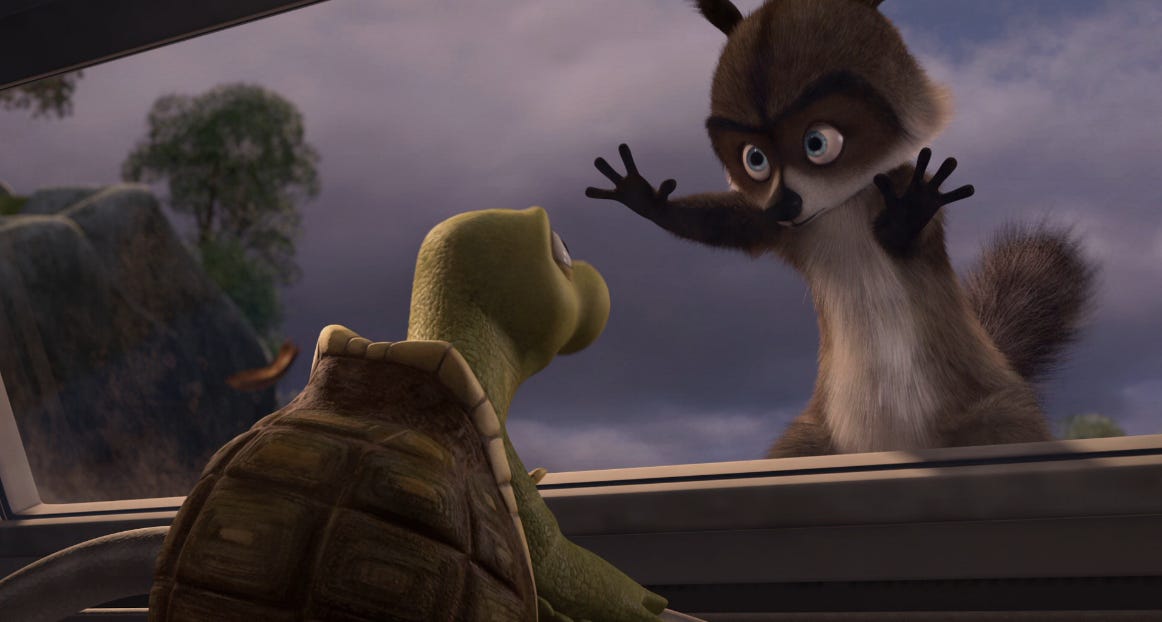
The Patoral Sage Verne recognises, however that RJ has now been imbibed with the intelectual philosophy of communal pastoral lore and declares his instinct to forgive him and offer their protection inside the community, in spite of his initial betrayal. An order everyone now follows as they know now that they must differ to the pastoral sage according to their nature.
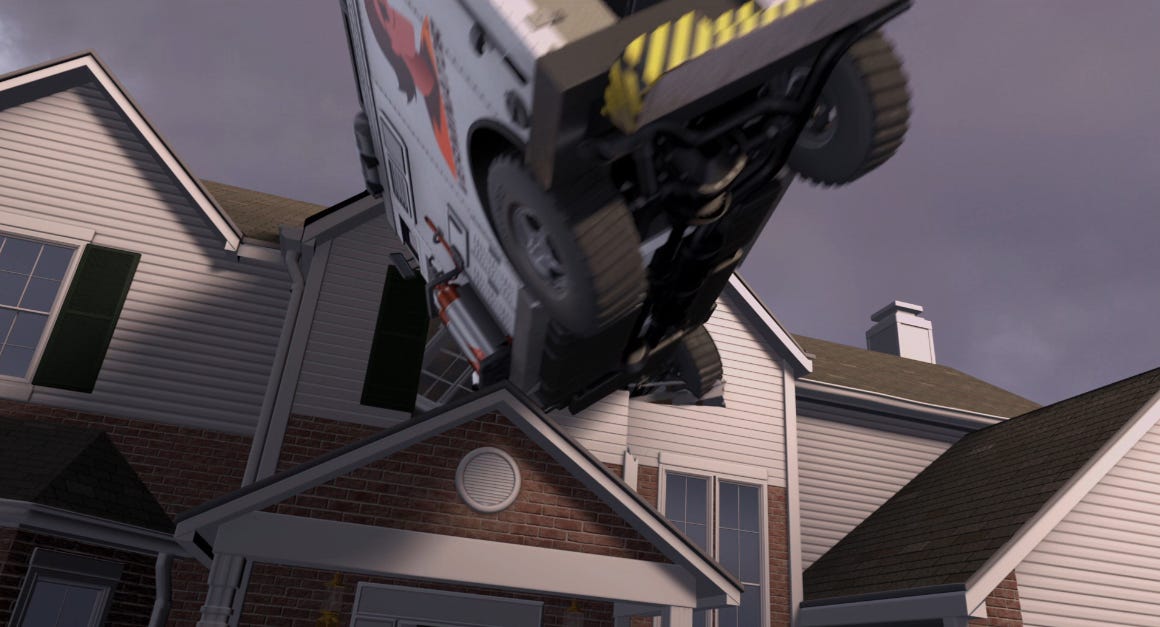
After an action sequence the truck crashes through the roof of the head of the Homeowners association with the exterminator inside and the animals all escape into the hedge.
After this we, enter a set-peice which draws the philosophical and intellectual dynamic of he film into scenery. Inside the Hedge the Community finds itself fighting between the 3 greatest antagonists of the Films. Vincent, the embodiment of Rationalist Libertarian Philosophy, The Exterminator the representation of the State’s monopoly on force and The Head of the Homeowners association, the representation of Boomer financial greed. Each descends on this tight knit disenfranchised community in an operation to destroy it.
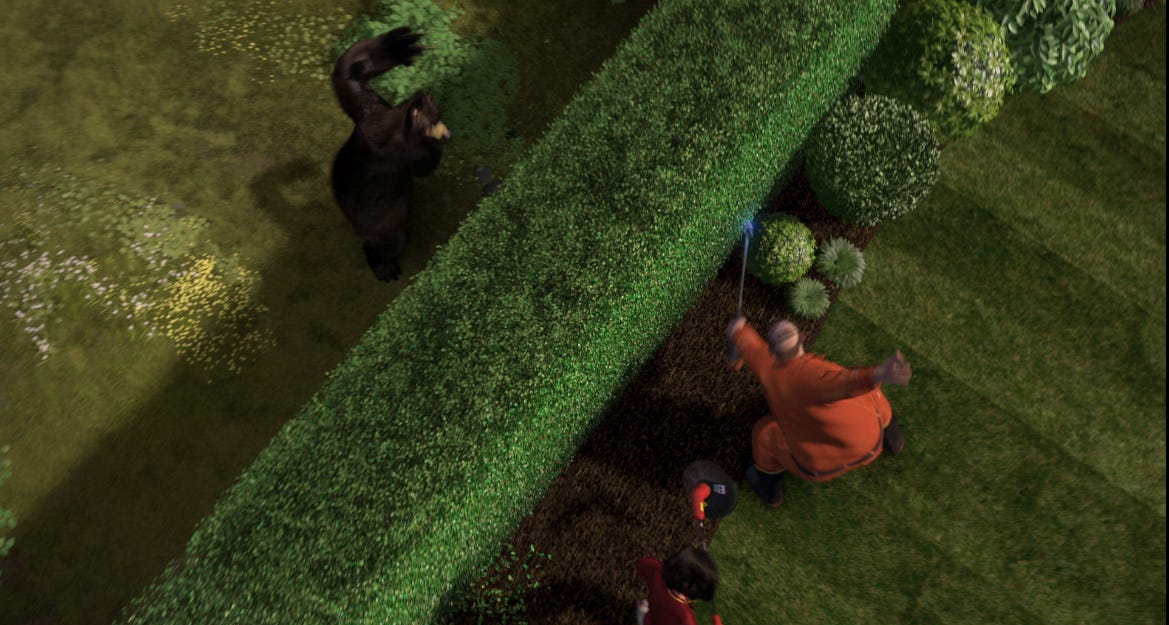
Soon comes the most legendary scene of the film, wherein Hammy the squirrel consumes a red-bull and in doing so inspires every X-men film ever as time slows down to a freeze and he traps all the film’s villains into an illegal snare they themselves installed.
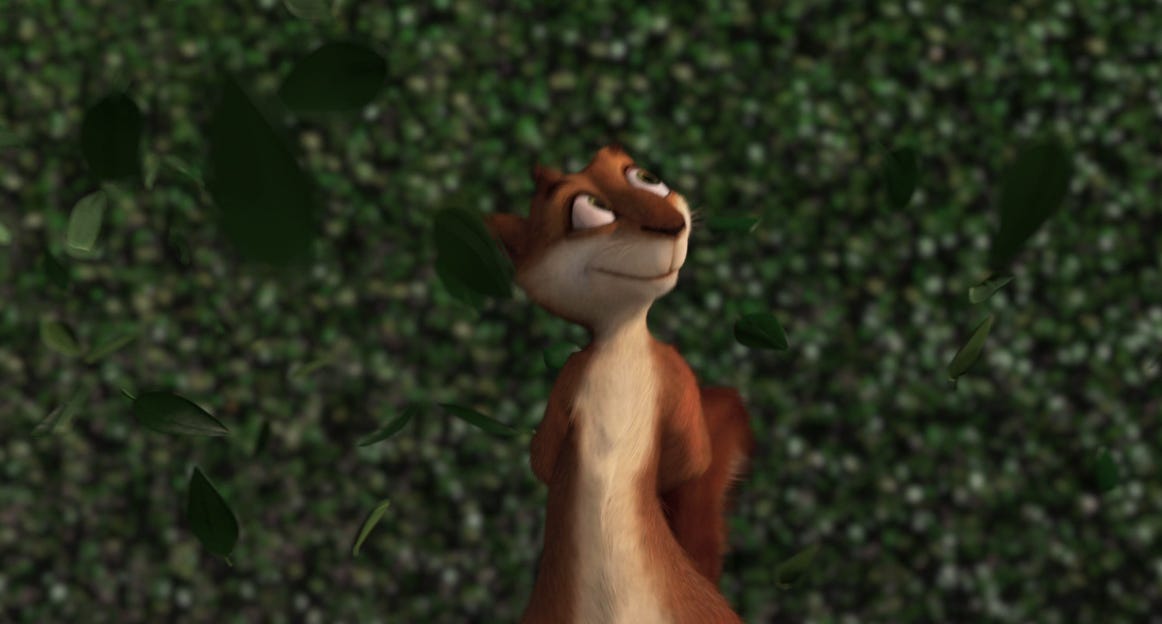
Following this an interesting line is exchanged. Verne takes RJ aside to tell him that if he had just told them from the outset that RJ needed the food to pay of an angry bear, the community would have helped him regardless.
Urban people have a general distrust of rural communities. This is largely founded in the intesity of generosity and mutual trust which such people provide and expect from one another. To an atomistic urbanite this is generally perceived as insincerity or otherwise personally overwhelming, the atomistic urban individualist fear of the archetype of the rural “cult”. RJ truthfully understood this and used this intense generosity and trust in a manipulative manner to ultimately to self-serve. Interestingly the entire extractive and manipulative convolution of this ruse went nowhere and was never required in the first-place anyway since trust was so high anyway in the first-place.
Ultimately the film ends with “nuts ex machina” as everybody learned that Hammy has discovered all the nuts he previously stored last spring giving everybody food to eat into the indefinite future.
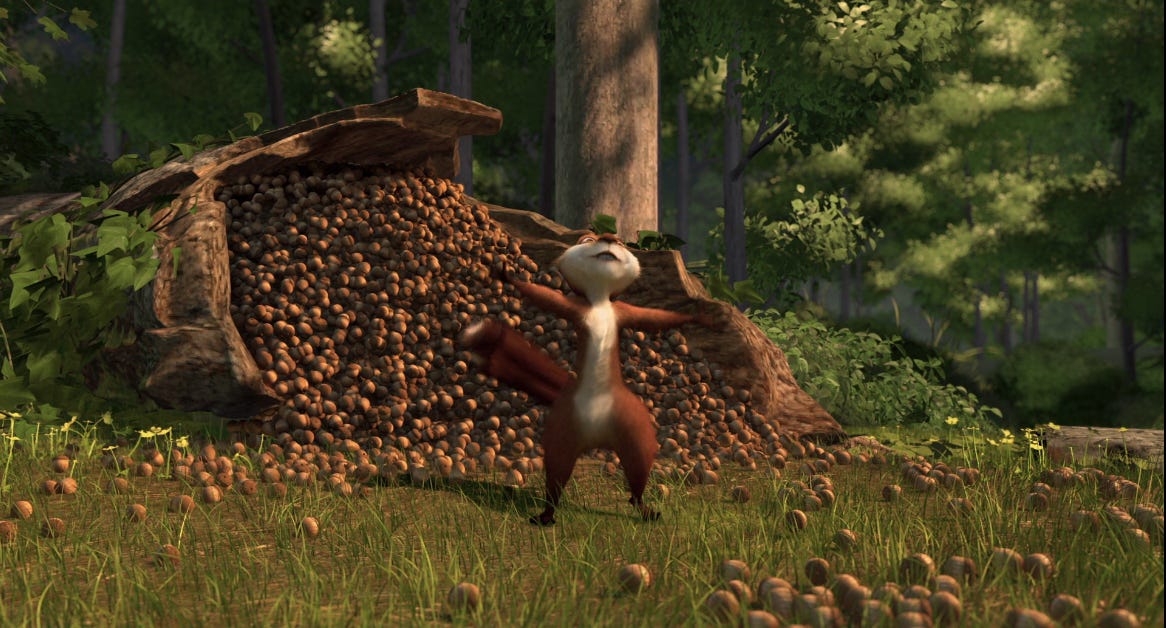
This final scene is the cause of a lot of controversy as according to critics as the ending seems nonsensical and unearned. In my opinion it is possibly a blunt symbol of the imminent bounty of community and pastoral tradition, Hammy hid the nuts long ago, they are only rediscovered when the animals, corrupted by modernity, reject it to return to their nature and their harmony.
It represents the depths of a bounty from returning to a tradition and way of life you once ignored. At-least this is what I think it means.
Overall Over the Hedge was panned by critics on it’s release, all of whom did not understand the complexity, satire and depth of the film, if not were actively alienated or even repulsed by it. The film came out in 2006, 5 years after 9/11 and in the heat of the war on terror and the upwell of patriotism which came with it, anything that seemed like it would be disparaging the American Lifestyle, culture and dream at this of all times would have gone down very poorly with cultural critics.3
Since then however, commentaries on the films socio-political, cultural and Religious allegories have been produced by people who were raised with the film, me included.
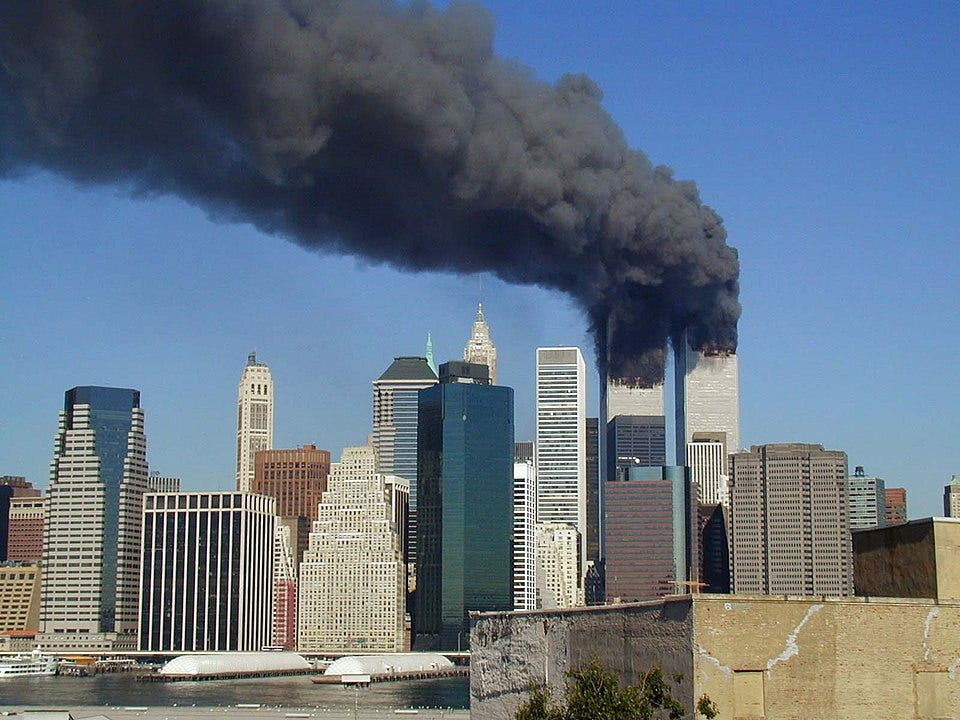
One idea I find interesting is that the community of animals are stand-ins for the primeval force represented in the 2000’s by the Taliban. Most Islamic terrorists were educated and experienced in western or western style secular education similar to RJ’s knowledge and understanding of urban civilisation. During the war on terror it were these people who were leading these hyper-religious fundamentalist groups, it was one of these groups, Al Qeada, who hijacked and crashed planes into the twin towers, just how the community of animals at the end of the film hijack and crash a pest-control truck into the house of the director of the Homeowner’s association from the air.
Osama Bin Laden chose to planes crash into the Trade Towers because he believed that it represented the financial malignancy and imperial centre of America. The implication is obvious, the United states is governed from the world trade towers, (and the pentagon), it was they that needed to be destroyed to “destroy” america.
Ultimately further analogies represent how the Afghan Taliban survived the war on terror, ultimately sucseeding by the US defeating itself by utilising it’s own apathy and hubris against it, similar to how Hammy, Verne and RJ defeated the antagonists of the film using their own hubris and aggression against themselves.
Generally the film portrays the themes and the forces of Organised Anti-Civilisation, “Barbarianism” – In this form through a coordinated pastoral anti-urban community, producing parallel institutions and tribal affiliations independent of the otherwise hegemonic urban empire. This community of animals are no different to Cossacks, Tartars, Jurchins, Vikings or Berbers as they streak, pillage and occupy civil positions in the empire of suburban America, getting beaten back intermittently only to return with time.
The film presaged the decline of the serene liberal American Empire, and it’s Pax Americana, alongside the symbolic collapse of the republic of Afghanistan, possibly Syria as well to the forces of traditionalist theocracy. The undulating anti-civilisational counter-culture continue to accumulate at the borders and the bearings of the governance of the modern age.
This is why the film is so impressive, It’s commentary on the modern empire of Liberal Peace and the contemporary civilizational discombobulation of most modern societies transcends the time it was produced, by some mystery speaking though the past into the future.
It is perhaps also amusing that Dreamworks Animations produced an implicity pro-al qaeda film in year 2006, and nobody noticed.
https://digital.nhs.uk/data-and-information/publications/statistical/health-survey-for-england/2024/adults-overweight-and-obesity
www.youtube.com/watch?v=WDy--5lR5SA
www.youtube.com/watch?v=vDjZAamU7PQ